The Minerals I Find

Petrified Wood
Petrified wood is ancient wood that has turned to stone over millions of years. As the original wood decays, minerals like quartz slowly replace it, keeping the tree’s rings and texture but turning it into a rock. Each piece is basically a fossilized snapshot of an ancient forest.

Basalt With Calcite Inclusions
Basalt is a dark volcanic rock that forms when lava cools quickly at the surface. After the basalt hardens, mineral‑rich water can seep into tiny cracks and empty spaces in the rock. As this water slowly evaporates, it leaves behind layers of calcite crystals. Over time, these calcite deposits fill the gaps inside the basalt, creating bright, lighter veins and pockets called “calcite inclusions” that contrast with the dark host rock.

Agates
Agates form inside empty spaces in volcanic rocks. First, gas bubbles in hot lava leave round holes as the lava cools. Later, mineral‑rich water flows through these holes and slowly deposits tiny layers of silica (quartz) along the walls. Over a long time, more and more layers build up in different colors, creating the banded patterns we see. When the surrounding rock erodes away, these agate‑filled pockets are left behind as solid, polished‑looking stones.

Rhyolite
Rhyolite is a light‑colored volcanic rock that forms from very thick, sticky lava rich in silica. Because the lava is so thick, it often traps gas bubbles and cools quickly at or near the surface. As it cools and hardens, it can create banded, flowy textures and sometimes tiny crystals or glassy patches.

Chert
Chert is a hard, fine‑grained rock made mostly of tiny crystals of quartz (silica). It often forms in layers within limestone or dolomite when silica‑rich fluids move through the rock and slowly replace it. Chert can be dull or slightly waxy, and it breaks with very sharp edges. It comes in many colors—gray, brown, red, or green—and has been used for thousands of years to make tools, arrowheads, and blades because it chips to a sharp edge.

Quartz
Quartz is a mineral made of silicon and oxygen (silica). It usually forms from hot, mineral‑rich water deep underground. As this water moves through cracks and open spaces in rocks, it slowly cools and begins to deposit tiny crystals of silica on the rock walls. Over time, more and more silica builds up, and the crystals grow larger, filling veins, pockets, or cavities. When the surrounding rock erodes away, the tough quartz is left behind as clear, white, or colored crystals and masses.

Red Jasper
.Red jasper is a type of chalcedony (microcrystalline quartz) that gets its rich red color from tiny amounts of iron. It usually forms when silica‑rich muds, ashes, or fine sediments are laid down in layers and then slowly harden into rock. As iron mixes in and oxidizes (rusts), it stains the silica deep red. Over time, pressure and mineral‑rich fluids compact and cement these layers, turning them into solid red jasper, often with bands, spots, or swirls.

Dallasite
Dallasite is a colorful, patterned rock made from altered volcanic material. It’s usually a mix of fine‑grained volcanic rock, quartz, and other minerals that create mottled, patchy patterns in greens, grays, whites, and sometimes reds. It’s tough, takes a good polish, and is popular for cabochons and display pieces.
Where Is It Found?
The name “Dallasite” comes from Dallas Road in Victoria, British Columbia, Canada, where it was first described and is best known. Collectors usually find it as rounded beach or shoreline stones and in nearby coastal exposures of old volcanic rocks.
.

Granite
Granite is an igneous rock that forms deep underground from slowly cooling magma. Because it cools so slowly, large crystals have time to grow, usually of quartz, feldspar, and mica. Over millions of years, uplift and erosion remove the rocks above, exposing the once‑deep granite at the surface as big masses, cliffs, and boulders.
.

Epidote
Epidote is a green mineral that usually forms when existing rocks are changed by heat, pressure, and hot, mineral‑rich fluids. It often grows in cracks and veins or replaces parts of other minerals.
You can commonly find epidote in:
-
Metamorphic rocks like schist and gneiss
-
Altered volcanic rocks
-
Quartz veins and calcite veins
Collectors often see it as green crystals or masses in mountain areas, road cuts, and rocky creek beds where these rocks are exposed.
.

Gneiss
Gneiss is a metamorphic rock that forms when other rocks, like granite or shale, are changed by very high heat and pressure deep inside the Earth. These forces don’t melt the rock, but they rearrange its minerals into light and dark bands. Over time, this banding becomes strong and wavy, giving gneiss its striped, layered look that stands out in cliffs, boulders, and riverbeds.

Ammonites
Ammonites are extinct, coiled marine animals related to squid and octopus. In Texas, they’re common fossils in ancient sea rocks from the Cretaceous period. You can find ammonites in many parts of the state, especially:
-
Central Texas – Hill Country limestones and road cuts
-
North Texas – Around the Dallas–Fort Worth area in chalk and shale
-
West Texas – In some desert outcrops and canyon walls
The Artisanal Journey of Geologic Creations

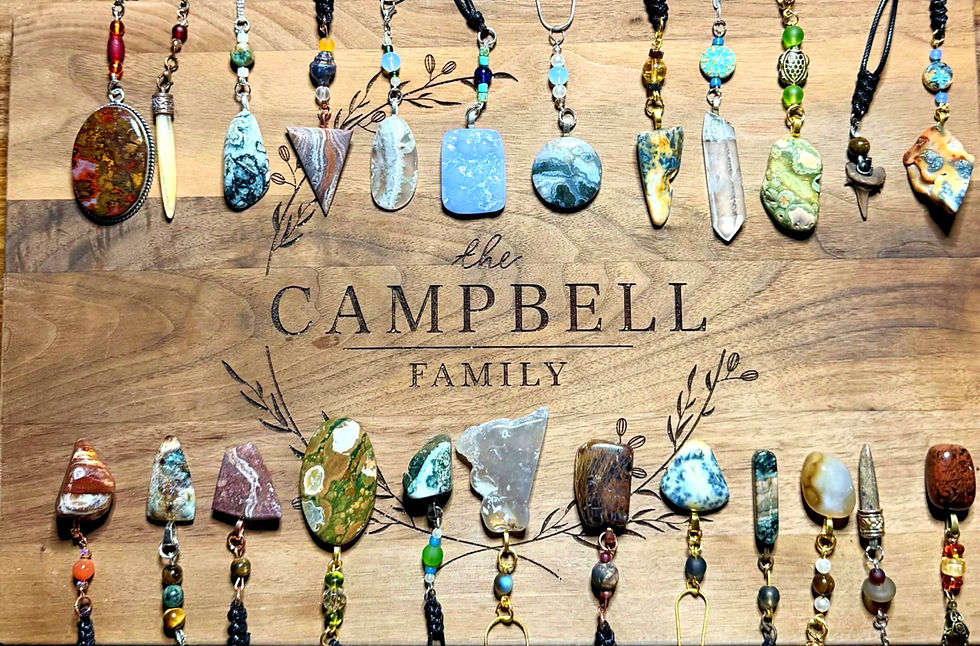
Our journey is rooted in a profound wonder for the secret gems tucked away beneath the soil. What began as a heartfelt adventure foraging for rare earth minerals has blossomed into a soulful craft where each handcrafted piece pays homage to the untamed spirit of the Texas landscape. We shape jewelry with deep intention, viewing every stone not merely as a decorative object, but as a living testament to millions of years of history. I find myself mesmerized by the ancient secrets locked within these fossils. In the vastness near Marfa, the desert transforms into a magical realm after sunset, where the horizon dances with mysterious lights and scorpions glow like neon ghosts as we seek out hidden agates by the ethereal glow of black lights. Texas is my heart and the sanctuary where my art breathes.
The Craft Process


01. Ethical
Foraging
02. Intentional Shaping
03. Soulful Adornment
Each piece starts with a quiet walk across the land at dawn. When the first light hits the ground at just the right angle, it makes every hidden crystal and jagged edge pop. I search through creek beds for a specific flash of color or a unique pattern, waiting for a stone that feels right—one with a vein or shape that tells a deeper story. I always tread lightly to respect the terrain, focusing on a patient discovery of that one special gem that truly speaks to me before returning to the workshop.
Right here in my Fort Worth garage, the excitement of the find turns into the steady work of a lapidary artist. I start by clamping a rough rock onto my 12-inch slab saw. As the blade hums and cuts, I keep a close eye on the water spray to make sure everything stays cool while those hidden internal patterns finally emerge. From there, I switch to a smaller ten-inch trim saw to cut away the bulk and find the best natural shape for the piece. The real magic happens at the cabochon machine, where I grind through several diamond-grit wheels. I take my time smoothing out every single scratch until the stone feels like silk in your hand and has that perfect, soft glow that really brings it to life.
Once the stone is polished, I set it into a piece that respects its long history. Most of these finds are turned into simple rings and necklaces you can wear every day, while others are made into pendulums used for Reiki healing and staying grounded. I take great care with every single piece I make, whether it is something to wear close to your heart or a tool for energy work. My goal is to create honest, sturdy jewelry that gives you a small, lasting connection to the earth while you go about your life.